
70,000 Followers. 16 Paying Customers.
Lessons from a somewhat failed product launch.

I launched my budgeting app two months ago.
After building the product, teasing it on social, getting people on the waitlist - I had 20 users.
At most. And then some of them canceled. Now I am at 15.
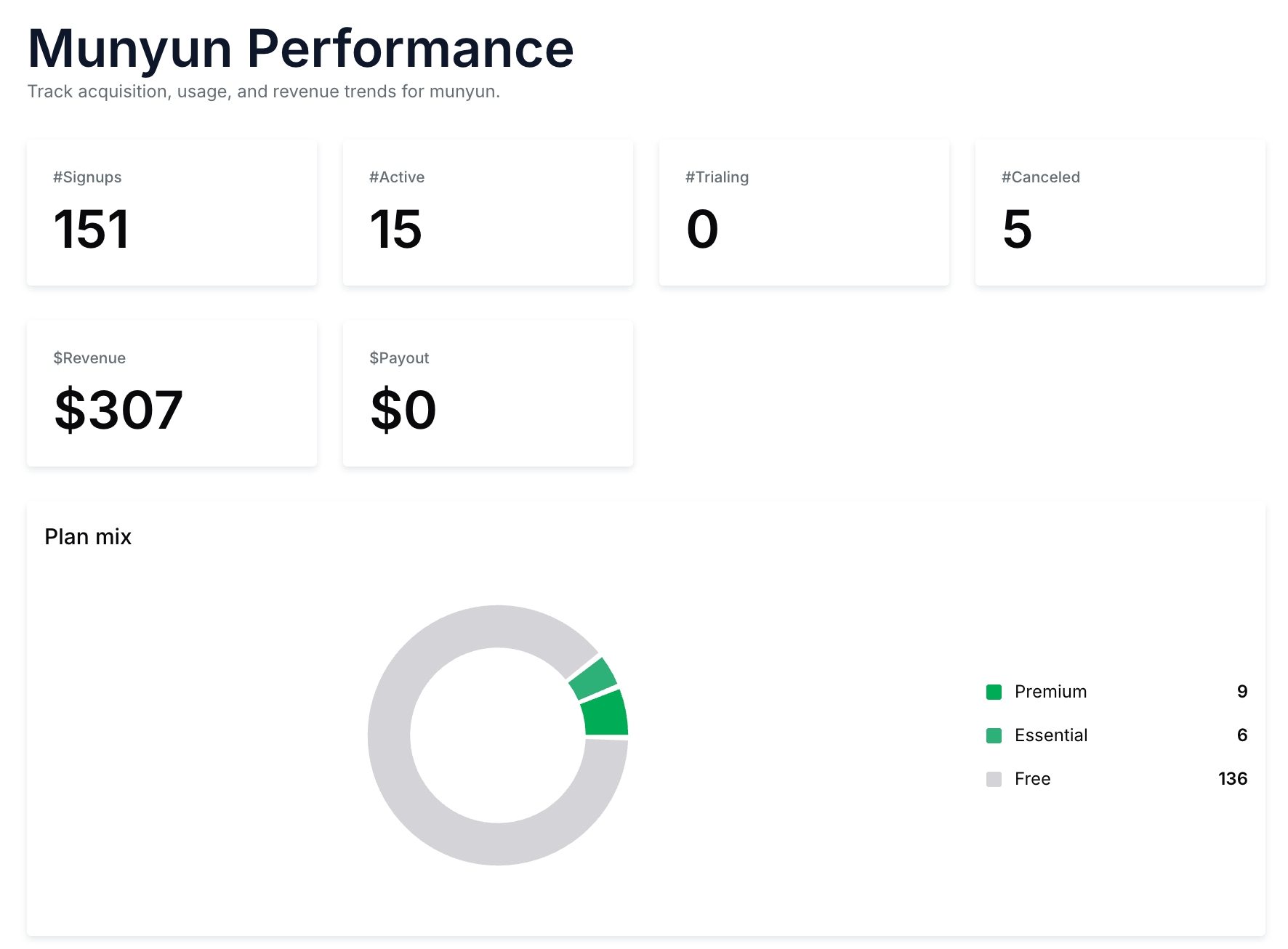
Let me put that in perspective. I have over 70,000 followers across my platforms. I’ve been creating content about personal finance for years. People trust me with their money questions.
And I couldn’t get more than 16 of them to pay me $10 a month.
That math is brutal. It makes you question everything.
Is my product trash?
Am I bad at marketing?
Do people even care what I’m selling?
Maybe I’m not as good at this as I thought.
For two months, I felt defeated. Lowkey sad as hell. Because what does it say about you when you have this audience and can’t convert them into customers?
Grounding myself back to reality
But here’s where I landed: I believe in this product. I know it works because I use it every day.
So it’s not the product. It’s me.
I didn’t know how to sell it.
And instead of feeling sorry for myself, I had to figure out how to fix it.
Does the world need another budgeting app?
Before I get into the strategy, let me explain why I even built this thing.
If you’ve been following me for a while, you know my stance on brand deals as a content creator. Yes, I’ve made good money from them. Yes, they’ve opened doors.
But here’s the trap nobody talks about: the more you rely on brand deals, the more you become a slave to the brand. And that sucks.
They tell you what to say. How to say it. When to post it. And eventually, you get to a point where you’re annoyed but you have no other option because that’s your income.
As a content creator, your greatest asset isn’t your editing skills or your ability to go viral.
It’s the audience you build and the trust they have in you.
I realized I needed to own something.
Not rent my audience to brands.
Own a product that serves them directly.
That’s why we have Munyun.
How will I improve Munyun’s marketing?
Here’s what went wrong with the launch.
I had no marketing strategy. None.
My entire plan was: post videos about it, mention it sometimes, and hope people sign up.
I know this sounds crazy - but I seen other people do it successfully…so why not me?
I had a waitlist, which helped build some anticipation (here’s the OG waitlist with the old app user interface). But once the product was live?
I had no clue who I was selling to or how to talk to them.
And that’s where I messed up.
With a product, I have to convince someone to give me their money every month. And if you know anything about the people who need budgeting apps - they’re already tight on cash. Now I have to convince them that spending money on my app is worth it.

I never defined who my ideal customer was.
And that’s embarrassing to admit because it seems so obvious.
Of course you should know your customer.
But I just thought: everyone needs help with money, so everyone is my customer.
That’s not how it works.
How do we fix this sh*t?
So I got help.
I don’t have the budget to hire someone full-time.
But I found someone with experience in SaaS marketing and paid $200 for 30 minutes of their time.
I reach out to Kira Klaas.
She is a beast.
Kira was Global Head of Integrated Marketing at Notion and is currently a VP at Later.
But most importantly she has a strong POV when it comes to building a brand and after reading some of her Substack articles (below) - she seemed to be worth every penny.

Before the call, I sent over my questions and gave her context on the app. And the biggest thing I walked away with was this: I didn’t know who my ideal customer was.
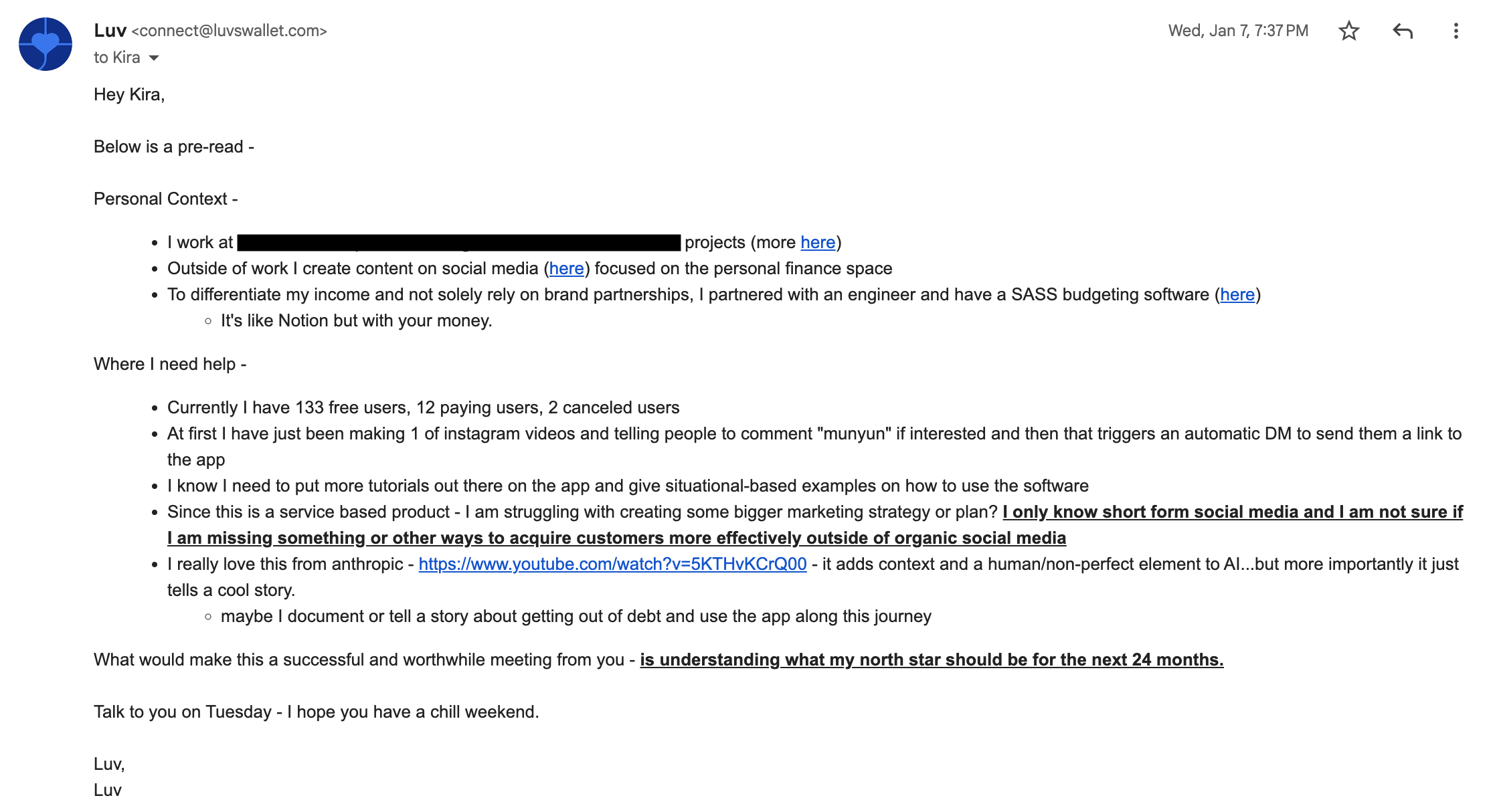
$200 advice
If you want the full breakdown just comment an I can send you it - but I left the meeting with 2 key insights.
1 - Tactic Vs Strategy
I was too focused on the tactics (creating videos, building websites, etc.) and not focused on the overall strategy.
This was a critical misstep on my end because without the clear strategy, more than most likely I would have ended up spreading myself too thin and ultimately working backwards.
2 - ICP and Value Proposition
ICP = Ideal Customer Profile
Basically it just means “who is this app specifically designed for?”
And I could not just settle at “people who want to budget”. Instead I had to dig deeper.
With limited data - I did a market analysis and tried to understand where there was opportunity in the market.
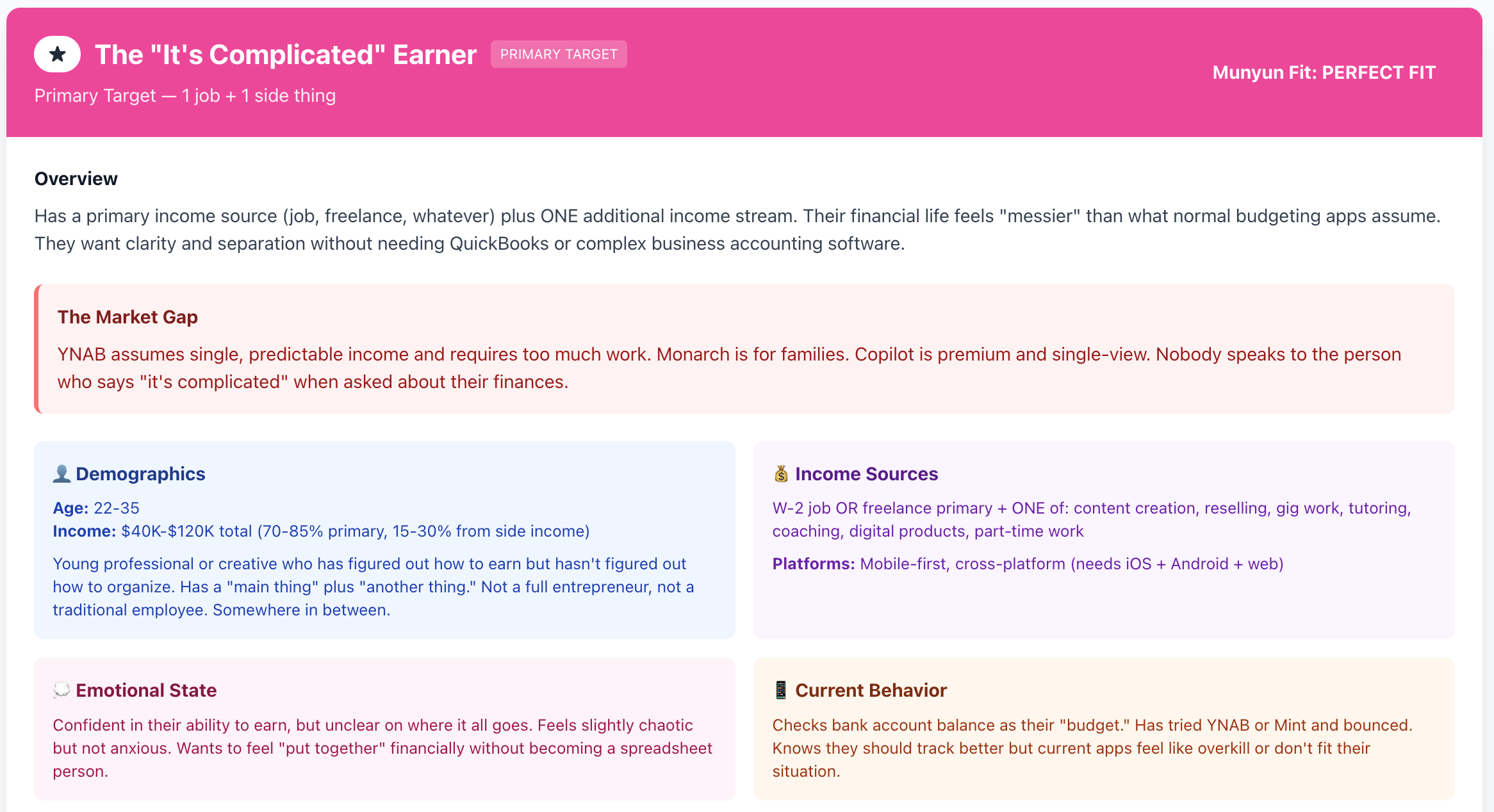
When you think about budgeting apps - not everyone who needs a budgeting app needs the same thing.
Some people have never budgeted before and need the basics.
Some people know how to budget but want a cleaner interface.
Some people want to budget as a couple.
I had to get specific.
And that specificity (an untapped market) is focusing on those people who work a 9-5 but also side hustles and side gigs but still want to keep both income streams separate for taxes and other reasons - but still want to view all their money at once.
I am only showing the final outcome - but best believe it took me 2 days questioning AI and looking at competitors to land to this distinction.
Now Value Proposition.
This is where you tell the user/consumer the real benefit. Instead of saying I help you budget - I need to evoke some sort of feeling or emotion.
I had to take a step back and ask myself - “while using this app, what is the bigger feeling?”
Getting out of debt? Reaching financial milestones? Getting Money Clarity?
In the moment - I had no clue on the correct answer.
But eventually I found the answer.
Customer feedback
The “a ha” moment came after I hopped on a call with a current user.
I was helping one of my paying customers troubleshoot something in the app, and he mentioned that his favorite feature was the multiple profiles.
He does personal fitness coaching on the side, and he loves that he can track his fitness business separately from his regular job.
And that lowkey resonated with me.
Because I’m in the same boat.
I have a 9-5 job and I create content.
And at times I want to see how much money my job brings in versus what my content brings in separately.
But I also want to see the combined picture.
And I started thinking: who else is like this?
Gen-Z! They love side hustles.
In addition to their 9-5 jobs - a lot of people are doing UGC, Uber Eats or other freelance gigs.
That’s an underserved market.
No other budgeting app is specifically positioned for people with multiple income streams. Sure, maybe other apps can technically do it. But their marketing isn’t speaking to that person.
This is where I need to focus.
Even when thinking about why people follow me.
They want to know how I manage my money, how I save, how I invest, how I’m building wealth while still having a regular job.
My entire brand is built on this.
So instead of just making content about budgeting in general, I can show them exactly how I budget with multiple income streams.
How I keep my content money separate from my job money.
How I track what my side business is actually making.
That’s my angle. And it’s authentic because it’s literally my life.
Lingering thoughts
Will this strategy work? I have no idea.
Maybe it will. Maybe it won’t. But I feel better about it than I did two months ago when I was just throwing content at the wall.
At least now I know who I’m talking to.
I know what problem I’m solving.
I know why my app is different.
The next step is execution. Going hard on organic content with this positioning.
Being intentional about the videos I make and the words I use.
I’ll probably come back in a month or two and tell you what worked and what didn’t.
This is all real-time. I’m figuring it out as I go.
But I’m done feeling defeated. I have a product I believe in. I have an audience that trusts me.
Now I just have to connect the two.
Let’s see what happens.
Luv,
Luv
If you made it this far (not asking for pity) check out the app @ munyunhq.com